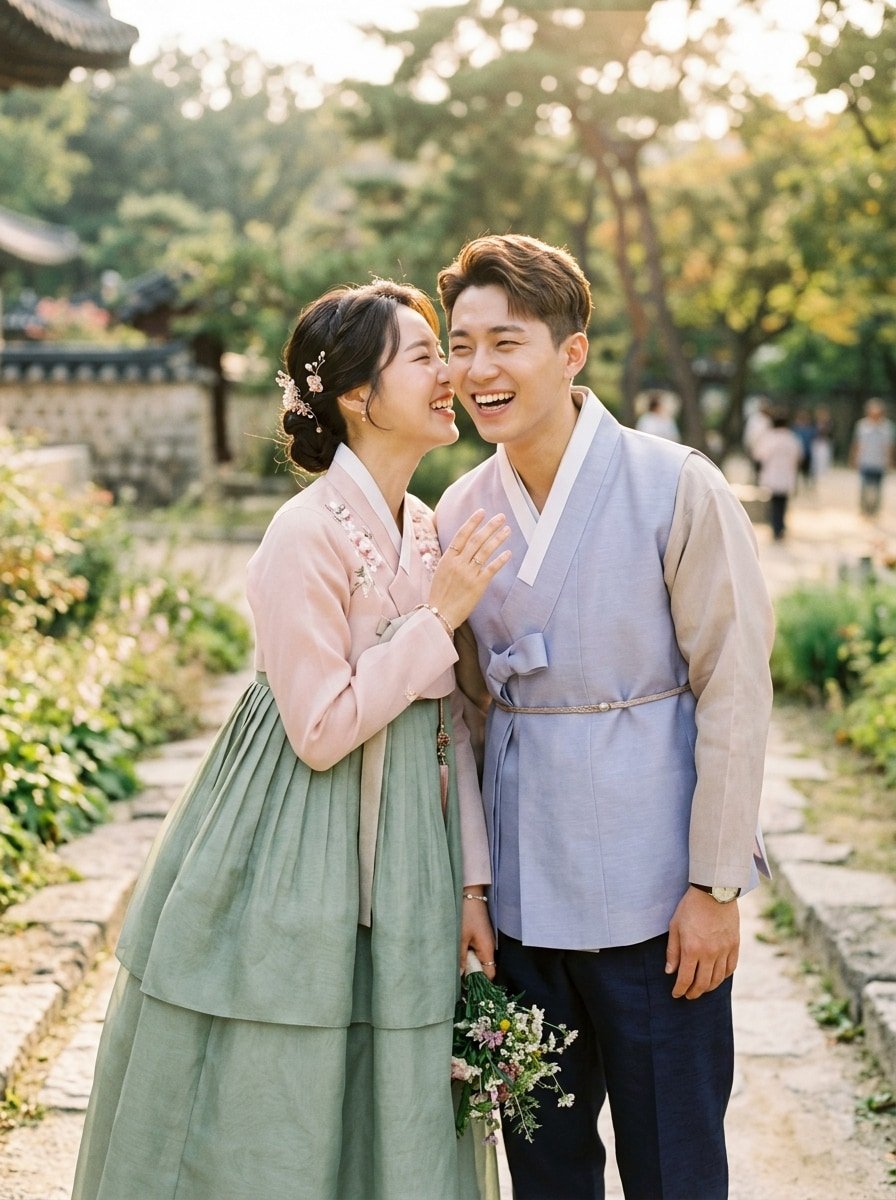
For many couples, especially those living far from where their families came from, the traditional-attire photo matters more than the white-dress one. It is the photo grandparents want, the one that goes on the wall in two countries, the one that says who you are. Each tradition has its own colours, backgrounds and posture, and photographing them well means respecting those rather than treating the outfit as a costume. Here is a practical guide to the most requested ones.
Korea: hanbok
Colours: bright, saturated silks; the bride often in red and green, the groom in blue or navy. Background: a hanok courtyard, a wooden gate, a plain deep-toned wall; avoid busy modern settings. Posture: upright, hands folded in front at the waist, a slight bow for one frame. A gentle smile rather than a wide one suits the formality. Seasonal frames under maples or blossoms are popular for pre-wedding sets.

China: qun kua and cheongsam
Colours: red and gold, with dense embroidery of dragons and phoenixes. Background: a red or dark backdrop, a traditional door, lanterns; keep the background simple so the embroidery reads. Posture: the bride’s arms slightly forward so the sleeves’ embroidery shows; the groom with a hand behind the back. A tea-ceremony frame with parents is essential in many families.

India: lehenga, saree and sherwani
Colours: red, maroon, pink, gold; increasingly pastels for modern couples. Background: arches, jaali screens, marigold garlands; golden hour outdoors is unbeatable for the metallic threads. Posture: the dupatta arranged over the head or shoulder is a whole composition in itself; give it space. Hands with mehndi get one close frame. Movement (a twirl of the lehenga) gives you the signature shot.

Vietnam: ao dai
Colours: red for weddings, often with gold motifs; the groom in a matching ao dai and khan dong headpiece. Background: a temple, a lotus pond, a plain pastel wall; the long silhouette wants full-length frames. Posture: standing tall, one hand holding the front panel lightly. Walking frames show the fabric’s movement.
Japan: shiromuku and montsuki
Colours: pure white for the bride’s shiromuku, black for the groom’s montsuki hakama. Background: a shrine gate, a garden with a stone path, a plain white or dark wall. Posture: still, composed, faces neutral or gently smiling. Frames with the wataboshi hood are traditional; one without it shows the hair.
Other traditions we are often asked about
- Nigeria (Yoruba aso oke, gele): bold coordinated colours, the gele’s shape needs headroom in the frame; a joyful, dancing frame is essential.
- Thailand (chut thai): gold and jewel tones, temple backgrounds, a wai gesture frame.
- Korean and Western mix: many Korean couples shoot both hanbok and a white studio set in one session; the two sit well side by side on an invitation.
Getting these photos when you live abroad
Renting authentic attire outside the home country is often the hard part, and photographers unfamiliar with the dress may not know how to arrange it. Three routes:
- Shoot on a trip home. Studios in Seoul, Hanoi, Mumbai and elsewhere offer attire rental, styling and a photographer in one package.
- Find a diaspora studio. Most large cities have a Korean, Chinese or South Asian studio that keeps attire and knows the conventions.
- Generate them. TwoShotPro’s heritage scenes include hanbok, qun kua, lehenga, ao dai, shiromuku, Yoruba and chut thai, built around your own faces from selfies, with the traditional backgrounds and posture. For couples who cannot travel before the wedding, it is a way to give the family the photo they were hoping for.
The photo your family was hoping for
TwoShotPro’s heritage scenes place you in hanbok, qun kua, lehenga, ao dai and more from a few selfies, with a free likeness check before you buy. From $29.